

What is Search Engine and how does it work – Google, Bing and Yahoo
What is a search engine? A search engine is an online tool that is designed to search for websites on the internet based on the user’s search query. I...
Read article
Internet Protocols are a set of rules that govern the communication and exchange of data over the internet. Both the sender and receiver should follow the same protocols in order to communicate the data.
These protocols manage the flow control of data; access control of the link being shared in the communication channel. For example, over the internet whenever we access a website or exchange some data with another device these processes are governed by a set of rules called the internet protocols.
You may also be interested to read about understanding what is Computer Network and how it works
An IP address is a unique 32-bit string of numbers separated by periods assigned to every device connected to a network that uses the Internet Protocol for communication. Each IP address identifies the device’s host network and the location of the device on the host network.
When one device sends data to another, the data includes a ‘header’ that includes the IP address of the sending device and the IP address of the destination device.
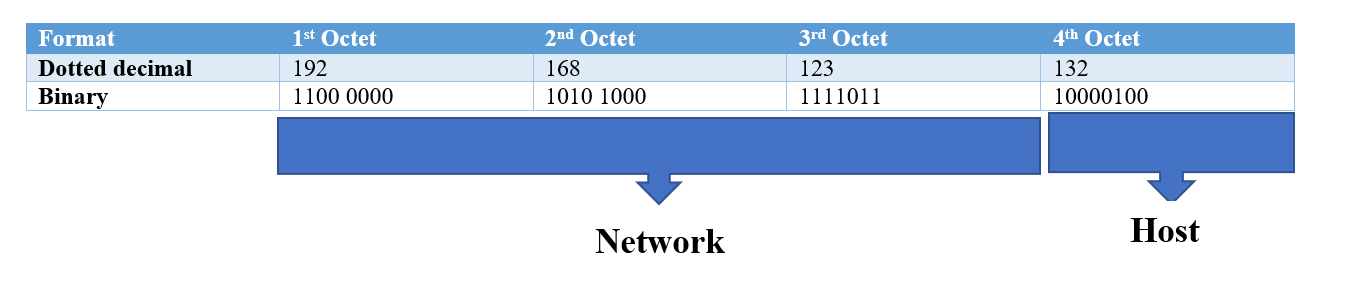
IP addresses are normally expressed in dotted-decimal format, with four numbers separated by periods, such as 192.168.123.132. To understand how subnet masks are used to distinguish between hosts, networks, and subnetworks, examine an IP address in binary notation.
For example, the dotted-decimal IP address 192.168.123.132 is (in binary notation) the 32-bit number 110000000101000111101110000100. This number may be hard to make sense of, so divide it into four parts of eight binary digits.

IPv4 addresses are further classified as either public or private.
IP addresses can be allocated manually (static IP address) or dynamically using a special program called DHCP (Dynamic IP Address)
IPv4 addresses are expressed as a set of four numbers in decimal format, and each set is separated by a dot. The IPv4 address has two parts, the network part (specifies the particular network to where the IPv4 address belongs) and the host part (uniquely identifies the device or the interface on your network). A subnet mask is used to identify these parts.
Categorizing IPv4 Addresses
Internet addresses are allocated by the InterNIC, the organization that administers the Internet.
IP addresses are divided into classes. The most common of them are classes A, B, and C. Classes D and E exist, but aren’t used by end users. Each of the address classes has a different default subnet mask. You can identify the class of an IP address by looking at its first octet.
The subnet mask is used by the TCP/IP protocol to determine whether a host is on the local subnet or on a remote network.
Class A network addresses are used by the government, ISPs, big corporations, and large universities. Class B network addresses are used by mid-sized companies and smaller ISPs. Class C network addresses are used by small offices and home offices.
N/B
The range for Class A is 0–127. However, the 127 network number isn’t used by hosts as a logical IP address. Instead, this network is used for loopback IP addresses, which allow for testing. For example, every computer that runs IPv4 is assigned a logical IP address such as 192.168.1.1. However, every computer is also automatically assigned the address 127.0.0.1, and any address on the 127 network (for example, 127.200.16.1) redirects to the local loopback. Therefore, this network number cannot be used when designing your logical IP network, but it can definitely be used to aid in testing.
The default gateway is the first IP address of the device that a client computer will look for when attempting to gain access outside the local network. This device could be a router, firewall, server, or other similar device; it is the device that grants access to the Internet or other networks. This device’s address is on the same network number as the client. So, for example, if the client is 192.168.50.2, the gateway might be 192.168.50.1
The domain name system (DNS) is a naming database in which internet domain names are located and translated into IP addresses. The domain name system maps the name people use to locate a website to the IP address that a computer uses to locate that website.
For example, if someone types “example.com” into a web browser, a server behind the scenes maps that name to the corresponding IP address. An IP address is similar in structure to 203.0.113.72.
Therefore, DNS server is the server or computer that resolves DNS addresses to IP addresses. This could be a Windows Server or an all-in-one multifunction network device—it depends on the network environment
Network address translation (NAT) is the process of modifying an IP address while it is in transit across a router, computer, or similar device. This is usually so one larger address space (private) can be re-mapped to another address space, or perhaps re-mapped to a single public IP address. This process is also known as IP masquerading, and it was originally implemented due to the problem of IPv4 address exhaustion. Today, NAT hides a person’s private internal IP address, making it more secure. Some routers only allow for basic NAT, which carries out IP address translation only.
A NAT implementation on a firewall hides an entire private network of IP addresses (e.g., the 192.168.50.0 network) behind a single publicly displayed IP address. Many SOHO routers, servers, and similar devices offer this technology to protect a company’s computers on a LAN from outside intrusion.
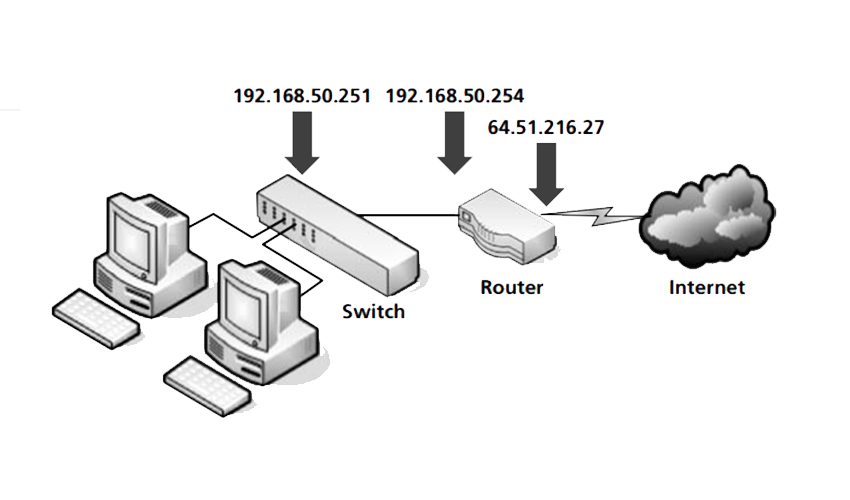
Figure above illustrates how NAT might be implemented with some fictitious IP addresses. Here, the router has two network connections. One goes to the LAN—192.168.50.254—and is a private IP address. This is also known as an Ethernet address and is sometimes referred to as E0 or the first Ethernet address. The other connection goes to the Internet or WAN— 64.51.216.27—and is a public IP address. Sometimes, this will be referred to as S0, which denotes a serial address (common to vendors such as Cisco). So, the router is employing NAT to protect all of the organization’s computers (and switches) on the LAN from possible attacks initiated by mischievous persons on the Internet or in other locations outside the LAN
What is a search engine? A search engine is an online tool that is designed to search for websites on the internet based on the user’s search query. I...
Read articleWhat is World Wide Web (WWW, W3)? The World Wide Web commonly referred to as WWW, W3, or the Web is an interconnected system of public webpages access...
Read articleIntroduction The Internet is an increasingly important part of everyday life for people around the world and keeps on defining how people co-exists wi...
Read article
Join the conversation
Leave a comment
Your email address will not be published. Comments are moderated before they appear.